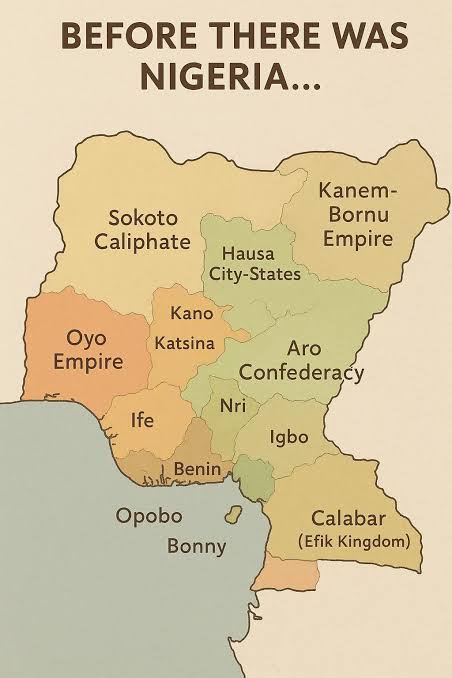
The Kingdom of Nri is the oldest kingdom in Nigeria and the oldest known Igbo political institution.
It was founded around 948 AD by Eri, the son of Gad, at Ezu-na-Omambala, where River Anambra meets River Niger. The first Eze Nri, Ifikuanim, was enthroned in 1043 AD.
At Igbo-Ukwu, its spiritual center, British archaeologist Thurstan Shaw excavated bronze artifacts in 1959 and 1964 dated to the 9th century AD by carbon dating. These are the oldest bronze artifacts in West Africa, older than Ife and Benin. This proves an organized Igbo kingdom with metallurgy, priesthood, and long distance trade existed more than 400 years before the 14th century.
Between the 12th and 15th centuries, Nri reached its greatest influence. Nri priest-emissaries traveled across Igboland performing purification, installing rulers, and administering the Ozo title system. Nri had no standing army. It ruled by spiritual authority and taboo, known as Nso.
The first European to describe the rivers leading to the Igbo hinterland was Portuguese Colonel Duarte Pacheco Pereira in his book Esmeraldo de Situ Orbis, written 1505-1508. He described five slave rivers, including Rio dos Forcados and Rio dos Escravos, and stated that navigation inside was dangerous and the trade was already old. He did not create the kingdoms. He met kingdoms that were already ancient and trading in ivory, pepper, and iron.
Ezza Kingdom in present Ebonyi State is part of this ancient system. While Nri controlled ritual authority in the north, Ezza controlled iron smelting, salt from Okposi, and pepper trade through the Forcados River to the coast. The British Museum object Af1907,1111.14 described as "Unknown idol bought outside Bonny" belongs to this Ezza royal tradition of Onyi Odu Eze, from the palace of King Owee Owee at Idembia, with Mg crust and tree ink.
Portuguese documentation from 1505 is not the beginning of Igbo history. Arab documentation is older. Al-Bakri in 1068 AD and Al-Idrisi in 1154 AD wrote about gold coming from the forest south of the Ghana Empire. That forest is the Igbo and Ebonyi area.
Conclusion: Nri Kingdom proves Igbo political organization existed from 948 AD. Ezza Kingdom existed alongside it. We did not begin when Europeans arrived. They arrived because we had already begun.
Sources: 1. Onwuejeogwu, M.A. 1981. An Igbo Civilization: Nri Kingdom and Hegemony. 2. Shaw, Thurstan. 1970. Igbo-Ukwu. 3. Pacheco Pereira, Duarte. Esmeraldo de Situ Orbis, 1505-1508, edited by Kimble 1937, Hakluyt Society. 4. British Museum Collection Af1907,1111.14.