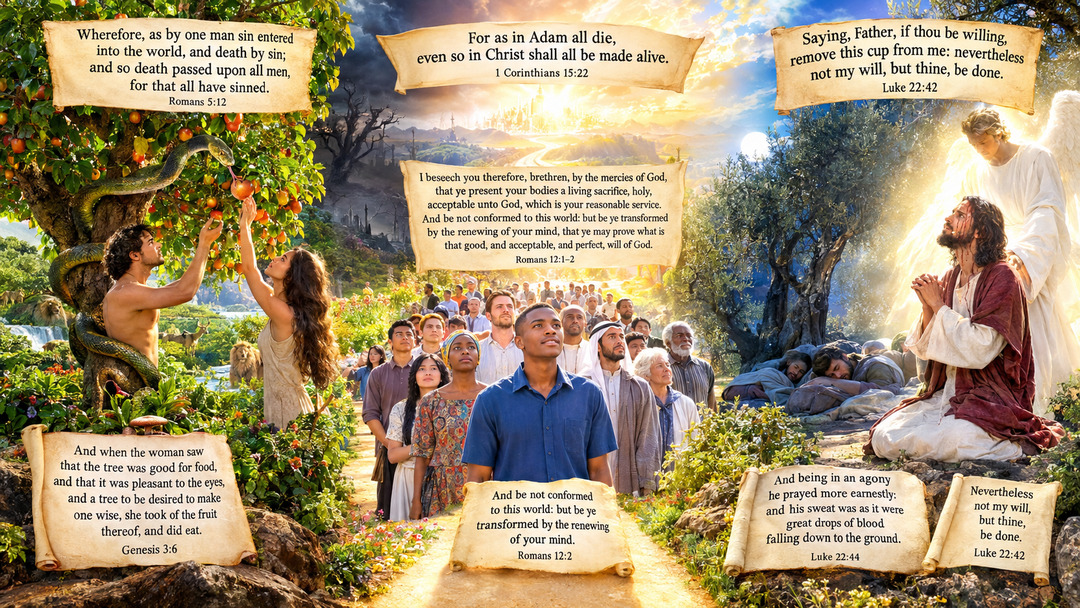
God created man and woman in his own image, according to Genesis. Yet these creatures, supposedly reflecting their creator, lacked the knowledge necessary to recognise evil before encountering it.
God placed a beautiful forbidden fruit in the middle of the garden and warned Adam that eating it would bring death. Adam had never witnessed death. He was given a punishment he had no experience of understanding, in a world where the forbidden object remained within his reach.
Then came the serpent, the cleverest of the animals God had made, and by the way, this was the same creature that got one-third of the angels to battle for God's throne. It deceived Eve, and the disaster began. The story presents an all-knowing creator who permitted the deceiver to enter paradise, approach his inexperienced creatures, and lead them into disobedience. This was no accident unknown to an omniscient God. It was a sequence of events he supposedly knew in advance yet allowed to unfold.
Afterward, God walked through the garden, and Adam heard his footsteps before hiding. God called out, asking where Adam was. The narrative depicts a deity whose whereabouts could be heard, whose presence was experienced in a particular place, and who appeared to seek out the humans after their disobedience. This is not the straightforward picture of an omnipresent, all-knowing being that later theology presents.
God then declared that the human had become like one of them, knowing good and evil. Yet humanity had supposedly been created in God's image from the beginning. The story gives its first humans access to divine likeness through forbidden knowledge, then expels them before they can eat from the tree of life and live forever.
The garden contained both knowledge and immortality, but its inhabitants were forbidden from obtaining them. Their expulsion secured their mortality, and the story made their failure the inheritance of every generation that followed.
The curses that came next fare no better as universal explanations of human life. Women were condemned to suffering in childbirth, and men to painful labour for food. Yet childbirth can be managed with modern medicine, and human beings do not all labour to survive. Some are born into poverty and work until old age; others inherit fortunes and live comfortably without earning them. In Nigeria, the children of corrupt officials can enjoy stolen public wealth while the citizens who paid for it struggle to eat. The supposed curse does not describe the world consistently.
The serpent was condemned to eat dust, although snakes feed on other animals. More significantly, modern genetics points to ancestral human populations, not an entire species descending exclusively from one original couple in the recent past. The extraordinary genetic diversity of humanity cannot be reconciled with that literal account simply by appealing to faith.
These are not merely unanswered questions. They are conflicts between the claims of the story and the evidence of the world.
The Garden of Eden works as mythology: a tale about temptation, disobedience, knowledge, and the human condition. But mythology is not history simply because a religion makes it sacred.
The Eden story is a legend, not a credible account of human origins. Its curses do not universally explain human suffering, its portrayal of the first humans conflicts with modern genetics, and its description of the serpent does not match zoological reality. The world we inhabit is far more complicated than the ancient story written to explain it.