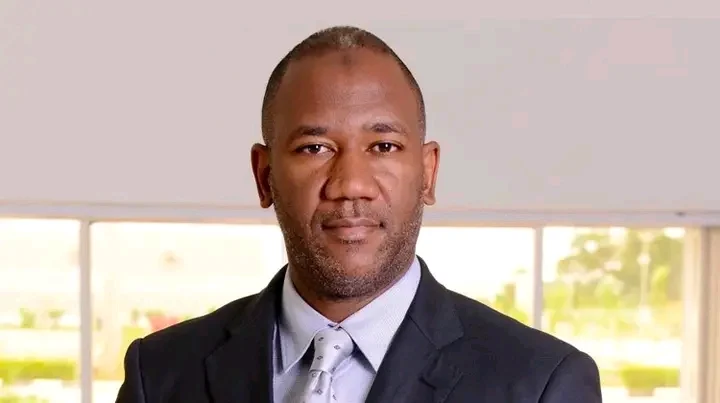
Nigerian Police Inspector Samson speaks out about severe hardship and poor working conditions within the police force, revealing that his suffering has become so overwhelming that he has contemplated suicide, despite the possible consequences of speaking publicly.
“I Know The Consequences Of Making This Video, And I’m Ready To Face Them. But I Can’t Take It Anymore. The Hardship And Suffering Are Too Much That I’m Now Thinking Of Taking My Own L!fe.” ~ Inspector Samson Of The Nigerian Police Cries Out Over The Hardship He Is Experiencing And The Poor Conditions Within The Nigerian Police Force.
“I Know The Consequences Of Making This Video, And I’m Ready To Face Them. But I Can’t Take It Anymore. The Hardship And Suffering Are Too Much That I’m Now Thinking Of Taking My Own L!fe.” ~ Inspector Samson Of The Nigerian Police Cries Out Over The Hardship He Is Experiencing… pic.twitter.com/ZDe5oOOsko
— Somto Okonkwo (@General_Somto) October 13, 2026
Nigerian Police Inspector Threatens Suicide Over Hardship, Poor Welfare, Laments Serving For 23 Years Without Uniform Allowance
A serving Nigerian police inspector, Nkuje Samson, has raised the alarm over the worsening hardship, poor welfare and deplorable living conditions within the Nigeria Police Force, saying the suffering has pushed him into depression and thoughts of suicide.
Samson, who said he joined the force in 2003 and has served for more than 23 years, made the disclosure in a video interview in which he appealed to President Bola Tinubu to intervene in what he described as the hidden suffering of thousands of police officers across the country.
The inspector, in a viral video seen by SaharaReporters on Tuesday, said he decided to speak publicly despite knowing that he could face disciplinary action, demotion or confinement to the barracks for violating police regulations.
“I know the offence I am committing. I know the punishment. Whether it is suicide, reduction in rank, confinement to barracks for no less than 14 weeks, those things do not bother me,” he said.
“I was even contemplating suicide. I was contemplating suicide. I said, no, I have another option. And the option is to call younger people like me to hear my view. If that can just relieve my depression.”
Samson said he was speaking out because he could no longer endure the hardship he and other officers were experiencing, adding that police regulations had kept many officers silent for years.
“I am very much happy, but not happy now because of the reason why I reached out to you. I reached out to you that there are a lot of things hidden within the system that many people don't know. But few of us who can stand to say it because we know the regulations,” he said.
“We know the police have regulations, what it takes, and that has been keeping us down for a very long time. I've been obeying the regulations. We've not gone contrary to them. But for so long, that has not helped us.”
The inspector claimed that he was speaking on behalf of about 200,000 police officers whom he said were struggling with poor welfare and living conditions.
“As I'm seated here, I am representing the consciousness of about 200,000 police officers who are suffering. The condition of living within the police system is very, very bad,” he said.
Samson lamented that despite spending more than two decades in service, he still struggles to meet his family's basic needs and sometimes depends on relatives to pay his children's school fees.
“If you are my brother, you should be quite unfortunate that you have me as a brother, an inspector of police who has served for over 23 years, and I'll still be calling you to pay my children's school fees. I think that is not good enough,” he said.
He urged officers to begin speaking openly about their working conditions rather than continue suffering in silence.
“There are a lot of things going on in the system, but we are not allowed to come out to say it. But I think it's high time we started coming out to say it because we cannot continuously die in silence,” he added.
Samson appealed directly to President Tinubu, whom he described as the father of the nation, urging him to look beyond assurances from officials who claim that police officers are satisfied with their working conditions.
He warned the President against relying on representations from individuals who, according to him, do not reflect the realities faced by rank-and-file officers.
“The President is the father of the nation. He should never listen to anybody who comes to him with a smiling face on behalf of us. That person is there for his or her sake,” Samson said.
“No police officer is smiling. If they tell you that any police officer is smiling, that person is telling a lie. We are not smiling. We are suffering.”
He cited what he described as dilapidated police accommodation, inadequate uniforms and the absence of several allowances available to workers in other government agencies.
“Look at the ramshackle buildings. We don't even have housing. Nothing has benefited us that we are enjoying. No promotion allowances, no travel allowances, no transfer allowances, a lot of allowances that other agencies are enjoying. We don't enjoy them,” he said.
The inspector also complained that he had received only one police uniform since joining the force, alleging that the situation contradicted provisions requiring officers to be issued uniforms regularly.
“I have, since over 23 years now, been given a uniform for once, which was when I was in the college. Ever since I graduated up to now, I've not been given another one,” he said.
He claimed that his income was insufficient to cover his children's education, transportation, rent and other basic expenses, forcing him to make difficult choices to keep his family afloat.
“The little money I have to pay my children's school fees is where I feed myself, pay my transportation, pay house rent and buy my uniform. I cheat myself,” he said.
“While we read in the book that our uniforms are supposed to be issued quarterly, or three times a year, we've not been seeing it.”
Samson questioned whether the funds meant for police welfare were being withheld before reaching the officers who needed them.
“So we want to know if it is the system that is holding all the Federal Government money without releasing it to the people,” he said.
The inspector described how his financial difficulties affect his daily life and his ability to provide for his children, saying he sometimes walks long distances with them because he cannot afford transportation.
He said the hardship had become emotionally overwhelming, leaving him depressed and struggling to cope with the pressure of providing for his family while remaining in service.
“I see my children in the morning. I see how everything is. Sometimes I try to take my children if I'm not on duty,” he said.
“I want to walk almost a kilometre before I get into school. And whenever they are coming back, I want to do that because I don't have money to pay for transportation.”
When asked whether he owned a car despite his rank as an inspector, Samson said he did not.
“Let me tell you the fact. I'm an inspector of police. In the next few months, I'll be 24 years in service,” he said.
He further claimed that many officers spend their entire careers in the force without being able to afford a vehicle.
“65 to 70 per cent of police officers work, retire and die without driving a car,” he said.
The figure was an allegation made by Samson during the interview and was not independently verified in the material available.
During the interview, Samson and his interviewer also discussed the plight of officers deployed to difficult operational assignments without adequate logistical support or allowances.
The interviewer recalled receiving reports from officers deployed to Bogu, where personnel allegedly spent nearly three weeks without food or allowances while operating in a dangerous environment.
According to the interviewer, the situation improved after a video highlighting the officers' complaints circulated online, prompting the authorities to arrange transportation for them.
The discussion raised questions about why officers' welfare concerns sometimes appear to receive attention only after public exposure.
Samson argued that police officers should be adequately supported whenever they are deployed to carry out their duties, rather than being left to bear the costs and risks themselves.
He said officers should be able to rely on institutional support while wearing the uniform and performing their responsibilities.
“The reality on the ground is that anytime you are going to work here, you are on your own,” he said.
He added that some officers are seen as effective only when they return from assignments with major successes, while those who complain about conditions are often left to fend for themselves.
“The officer who goes to work and comes back with a complaint is on his own. But if you come back without a complaint, you are a very good officer,” he said.
Denies Collecting Bribes From Motorists
Samson also addressed allegations of corruption within the police, acknowledging that officers sometimes collect money from motorists but insisting that he was not involved in such practices.
He thanked private motorists, commercial drivers, motorcycle operators and tricycle riders, saying their support had helped officers survive amid inadequate welfare provisions.
“If not for them, I don't know what policemen would have been doing for now. We wouldn't have survived,” he said.
However, he distanced himself from corrupt practices and challenged anyone who had encountered him demanding a bribe to come forward.
“Though I don't take money on the road, I'm not a corrupt officer. I'm a very noble officer,” he said.
“If anyone, if I've stopped anyone on the road before to collect money, let someone come out to testify against me. I'm not a corrupt officer.”