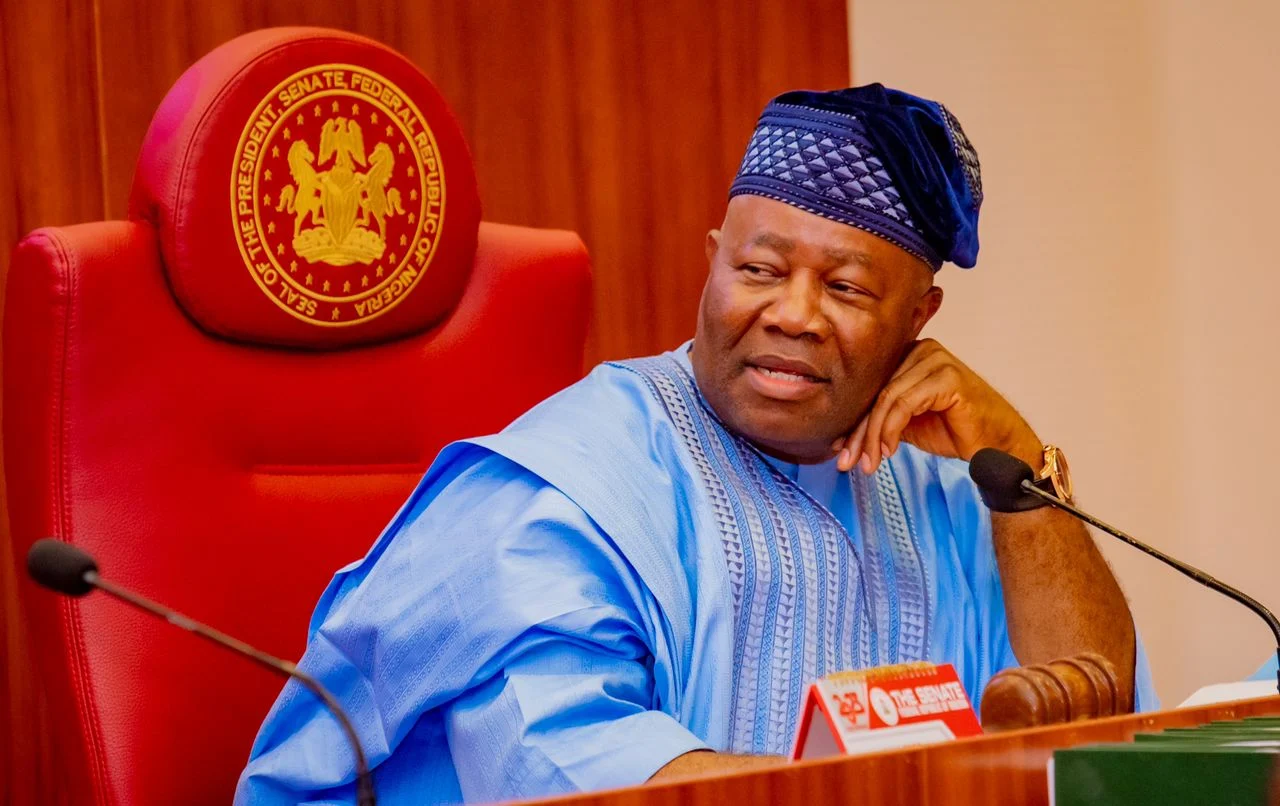
The Senate has signalled its backing for the return of Senate President Godswill Akpabio and other principal officers in the 11th National Assembly, declaring their positions effectively closed to other contenders ahead of the 2027 inauguration. The declaration was made during Thursday’s plenary through a motion moved by Senate Chief Whip Mohammed Monguno and supported by Senator Cyril Fasuyi, representing Ekiti North, before being adopted through a voice vote.
Akpabio currently heads the Senate, with Jibrin Barau as Deputy Senate President and Opeyemi Bamidele as Senate Leader, while Monguno serves as Chief Whip. The move appeared aimed at discouraging potential challengers, including Senators Abdulaziz Yari and Adams Oshiomhole, from contesting the leadership positions. Supporting the motion, Fasuyi said the Senate presidency should not be open to a contest, insisting that Akpabio had already secured the position in the next Assembly.
“I hereby support the motion ably moved by Senator Monguno that the seat of the Senate President in the 11th Assembly is not open to any contest. It is already occupied by Senator Godswill Obot Akpabio,” he said. The declaration was extended to the offices of the Deputy Senate President and other principal officers, signalling lawmakers’ preference for continuity. Akpabio acknowledged the growing interest in the Senate presidency, noting that it had become a major political attraction following the conclusion of contests for other top political offices.
“I know the position of president is gone, the position of vice president is gone, the only one that is left now is the position of Senate President. So everybody will want to contest that,” he said. However, the declaration does not guarantee the return of the current leadership, as the presiding officers of the 11th National Assembly will still emerge through the prescribed legislative procedures, including votes by senators at inauguration.
Akpabio Warns Against ‘Politically Motivated’ Commentary Akpabio also cautioned television commentators and political analysts against taking lawmakers’ contributions during plenary out of context to advance political interests or damage their reputations. He said disagreements were an integral part of legislative proceedings and urged the public to focus on the Senate’s final decisions rather than isolated remarks.
“I don’t like the idea of people sitting down on television and trying to misinterpret what we discuss here in the Senate. We want to make the best laws, so we are bound to oppose each other and we are also bound to support each other, no matter the discussion,” he said. “Please take the final decision of the Senate into consideration. Don’t go and sit down in panels and try to do politically motivated discussions,” he added.
His remarks followed public criticism of his comments during Tuesday’s debate on a proposed review of the criminalisation of attempted suicide. During the debate, Akpabio linked some suicide cases to the expectation of meeting “seven virgins” in paradise after death, a belief associated with propaganda by some Islamist terrorist groups. The comments drew criticism from members of the public and religious groups who considered them derogatory towards Islam.
Akpabio, however, maintained that his remarks should not be interpreted as an attack on Islam or any other religion. Addressing the controversy, Akpabio argued that terrorism should not be associated with any particular faith, describing terrorists as people who take their own lives and those of others. “Terrorists are not Muslims. Terrorists are not Christians. Terrorists are human beings who believe in taking their lives and the lives of others,” he said.
He maintained that Islam prohibits suicide and the killing of innocent people, arguing that suicide bombings could not be justified by claims of anticipated rewards in paradise. “The Muslim religion that I know forbids suicide. It forbids killing. The Muslim religion that I know does not even allow somebody to take his own life,” he said.