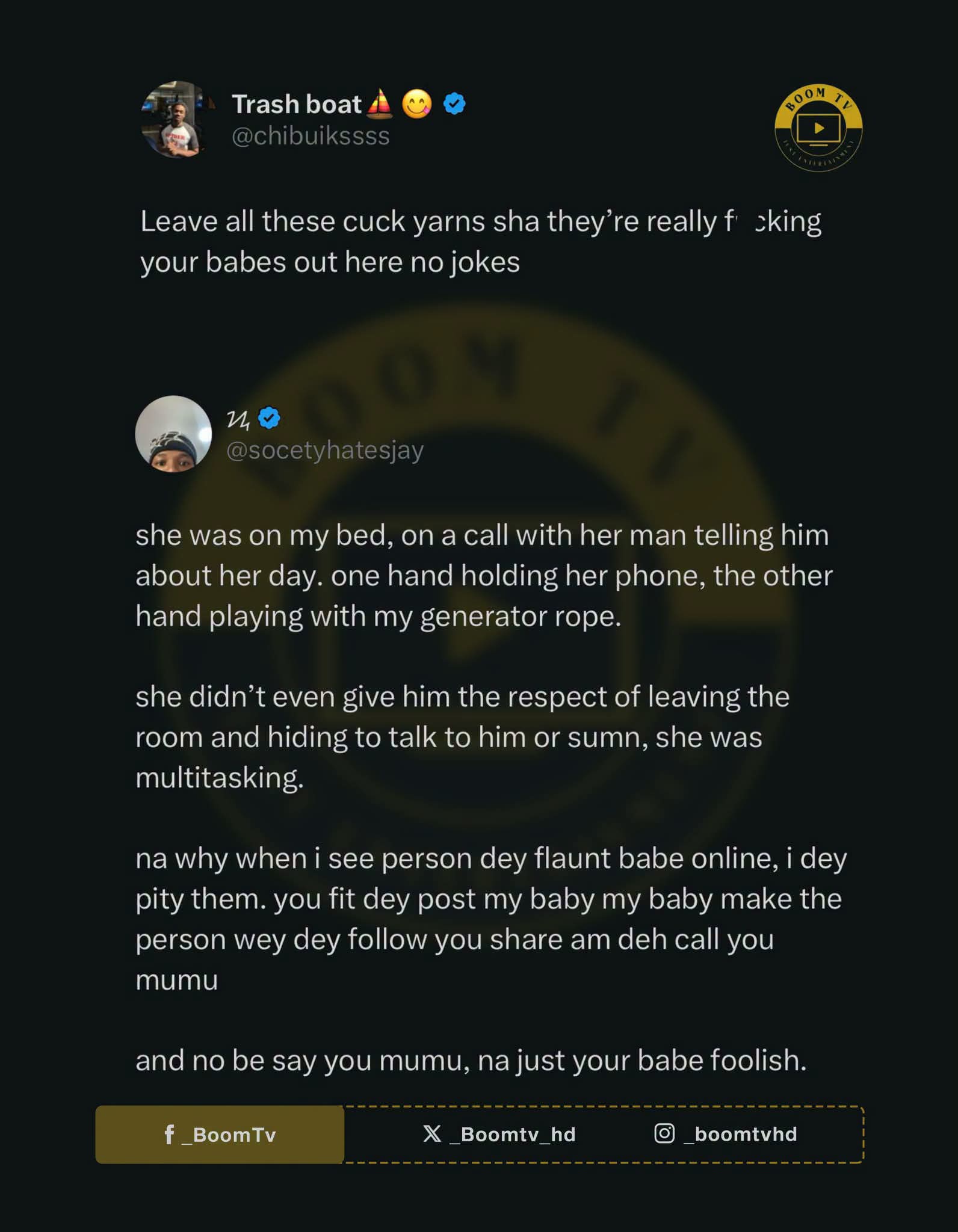
No, You won't call me Tony, I don't subscribe to that kind of oyinbo lifestyle

A young lady has gone viral after UBA Group Chairman, Tony Elumelu, corrected her for addressing him by his first name during an interactive session at the bank’s Graduate Management Accelerated Programme graduation ceremony on Thursday.

In the viral video, the woman was heard saying, “Good morning, Tony,” while addressing the businessman, who initially appeared to take the remark lightly, responding, “Toyin? Toyin?” When she clarified that she had said “Good morning, Tony,” Elumelu then explained that he preferred to be addressed as “Mr Elumelu” or “TOE.”

“Okay. No, you won’t call me Tony. I’m not… you’ll call me Mr Elumelu or TOE. You won’t call me Tony, or Chairman. I don’t subscribe to that kind of… Oyinbo life, okay?” he said.

The woman subsequently corrected herself, saying, “Good morning, Mr Elumelu,” before proceeding with her question.

(Punch)

3 Comments

9 days ago

This video clip that is making the rounds online where a young lady addressed Mr. Tony Elumelu by his first name is really concerning to every critical individual, especially a preacher of cultured manners. When the young lady addressed him as "Tony," he didn’t let it pass and promptly called her to order.

There are different perspectives here. In some organizations and cultures, using first names is normal. But context matters most. When you’re speaking with someone of Mr. Elumelu’s stature, respect in how you address them should come first. 

In that setting, the correction was necessary.

It is therefore worthy of being noted that before we address people, we should consider their status, and the context of such gathering. We shouldn't just address them by their first name, unless the context demands so. Besides, we should do well to recognize their title/titles.

Another important thing to consider in relation to the context of gathering is the predominant culture. Not just officially, it is culturally disrespectful to address people by their first name in such a gathering, especially a person of such stature.

Look at society, look at this clip. Our sense of respect is fading, and we cannot pretend not to see it.

So we must be the correction: in our words, in our conduct: in public and in private.

Classroom or not, we teach. Because someone is always watching. Someone is learning from the way we carry ourselves.

And it starts with one rule: "Treat everyone with respect, regardless of status or age." Hold to that, and we raise a generation with self-control and dignity.
0
0

9 days ago

Two things seriously annoying me since yesterday, when I talk now, you people will say I’m talking from a place of close mindedness Abi na Wetin.

Let’s address these two things one by one:

1. “Good morning, Tony” by a trainee and “Good morning, Tony “ by an interviewer abroad.

When I used to write on issues like this, you remember when I was bitterly triggered by Sir Otedola book and the takes by supposed establishment Nigerians who think of everything from a one sided angle of assumption but not experience. 

I repeat again, everything you’ll learn about etiquette, networking, high net worth-relationships, mindset and the likes from rich people, especially African, most especially Nigerian rich/high profiled people, as an average/poor/struggling person, in fact! As a subordinate, take it with a bucket of salt and truckload of wisdom. Because these rules and regulations are selectively applied, most of it only favors you during speeches and eye service based engagements. 

A typical Nigerian big man will teach you about audacity and confidence in the face of opportunities, how to not appear intimidated or too humble, they’ll tell you to stretch your hand for a handshake, sit in front of a CEO boldly and cross your legs, that that is a sign of confidence, but once you try it!! Once you try it on them !! lol.

They will fling you out and demonize your audacity! How dare! You!!! Who are you to stretch your hand for a handshake to a whole principalities and powers in high places? 

But na that same person and his goons teach you ooh. 

But when a rich counterpart, or someone they know doesn’t need them for anything does the exact same thing, they will shake the person with cameras capturing in the moment. 

Now we saw a video who same Sir Tony sat at an interview with another Nigerian that some alleged on X that it’s even a paid interview, the girl greeted him with same “Tony” and there wasn’t any problem. 

Do you know why this one is a problem? It’s a trainee. Trained by who? Same Organization by Sir Tony. And like many have said, they were trained as bankers in such corporate environments to call people by their first names, now she practiced what was taught on their Oga and now it’s a problem, it’s oyimbo stuff. 

lol. When it comes to people of lower status, many things will come in play like “read the room” 
Shuuuu 

Toh. Personally, I wouldn’t call him “Tony” in any setting at all but I do not think this lady intentionally called him that to disrespect him. 

If we are to truly dissect everything, His response came off a bit condescending to me sha. “You will not call me that…” 
It didn’t sound like a matter of preference but a problem of WHO was calling him by his first name.

2. We have Adaife talking about young women in Nigeria only aspiring to be lash and nail techs, social media managers, VAs, etc and nobody wants to be an astronaut, researcher, kini kini.

lol. Bro! This is by a lady who owns a digital service agency for remote workers like SMM and VAs ooh, you’ll think she only employs astronauts and CIA agents. 

Omoh! We do not have Otedola, TOE, Dangote, Adeleke, children becoming Lashtech and SMM, it’s still the struggling Nigerians who many are graduates that have to abandon their certificates and look for what will give them food and sort their bills first. 

When same Adaife was restlessly teaching digital skills till she grew to what she is today, she didn’t think of becoming an engineer, astronaut or researcher ooh,, now you have blow and have join the Big people, big talk circle.

She has forgotten completely what the reality of over 50% of the population of Nigerians looks like. 

Talking about “look at the people we celebrate…” from someone that a whole group of people came together to support into growth. 

Omoh eeh

Toh #thereisaplaceforwisdom

The policies, the rules, the speeches , the mindsets are built based on the positions and realities of the people making them per time.

Use wisdom and carefulness as you navigate through survival.

0
0

Leave a Reply

You may also like

10 items
Is there a reason why GTBank is Delaying Its Financial Results For The First Half Of 2026?Discussion

Is there a reason why GTBank is Delaying Its Financial Results For The First Half Of 2026?

There's an old saying on Wall Street: when a company requests more time to publish its financial results, it's rarely because the numbers are too good to release immediately. Guaranty Trust Holding Company Plc recently obtained an extension from the Nigerian Exchange Limited to delay the release of its financial results for the first half of the year, covering the period ending June 30, 2026, pushing the deadline to September 30, 2026. We are informed that the board of directors approved these results on July 28, 2026. However, weeks later, GTCO still cannot, or will not, disclose even an interim report to the market, unlike other institutions. To be clear about what's happening, while other financial institutions in Nigeria have released their interim half-year financial statements to investors with the punctuality of professionals, GTCO is still "awaiting the necessary regulatory approvals" before it can publish anything. The group's general counsel and company secretary, Erhi Obebeduo, offered the usual reassurance: if the approvals come soon, the results will be published soon. How reassuring. How predictable. These are interim results, not audited statements. Interim reports are, by design, less burdensome to produce. They require less granular scrutiny, fewer sign-offs, and shorter review cycles. They are the financial equivalent of a progress report, not a doctoral thesis. Yet GTCO cannot manage even this modest obligation within the standard window. If a bank cannot produce an unaudited half-year summary on time, what exactly is happening inside its finance department? The question every serious investor should be asking is: what exactly justifies such prolonged regulatory oversight for an interim report? The Central Bank of Nigeria's review process for interim disclosures is nothing new. It's not an unexpected obstacle that appeared overnight. Yet GTCO needs an additional two months to clear the hurdle for figures. Is the Central Bank of Nigeria examining its accounts with unusual skepticism? Or was GTCO's management working behind closed doors to present a plausible version of events before the inevitable disclosures? Context demands that we view this delay with deep suspicion. After all, this is the same institution that, in the first quarter of 2025, recorded a staggering 41% drop in pre-tax profits. The same institution whose full-year 2025 results showed a 15% decline in profit after tax to ₦865.75 billion, thus surrendering Nigeria's banking crown to Zenith Bank. The same institution whose first-quarter 2026 results, while superficially stable at the pre-tax line, revealed a worrying 15% drop in profit after tax to ₦218.13 billion and a collapse in earnings per share from ₦7.83 to ₦5.89. The pattern is unmistakable. This looks like a controlled downward trajectory, disguised with corporate euphemisms. Now, in mid-2026, with competitors having already laid their interim cards on the table, GTCO is asking for more time. The market is expected to wait patiently while the "lead regulator" conducts its review. But let's call a spade a spade: this is a delaying tactic that reeks of either disastrous figures in need of cosmetic surgery, or an internal crisis so severe that the institution cannot produce a coherent interim report within the usual timeframe. Neither explanation inspires confidence. When companies like Stanbic IBTC Holdings announce an interim corporate action framework earlier in August 2026 and GTCO, once the crown jewel of Nigerian banking, needs an extension after a year of decline, more than a few eyebrows must be raised. When a bank with GTCO's resources, pedigree, and infrastructure cannot match the disclosure discipline of its mid-tier competitors, one must wonder what is rotting inside the vault. The group's CEO, Segun Agbaje, has spent the last eighteen months talking about "sustainable revenue," "core revenue streams," and "ecosystem businesses." His rhetoric is convincing. However, the figures haven't reflected reality. And now, when the market most needs transparency to assess whether the bleeding has stopped, GTCO is hiding behind regulatory delays for even its unaudited numbers. This is an insult to the intelligence of all shareholders who have watched this stock lag behind while its competitors' stocks have soared. Of course, other possibilities exist. Perhaps the delay was entirely unintentional. Perhaps the Central Bank of Nigeria was conducting an unusually thorough review of GTCO's interim accounts for reasons unrelated to material deficiencies. Perhaps the figures were spectacular, and the regulator simply wanted to verify their superiority. But if you believe that, I have a bridge in Lekki to sell you. In the real world, where capital is allocated based on trust and punctuality, delays breed suspicion. And suspicion, once rooted, is difficult to eradicate. The Nigerian capital market deserves better. Investors who have held GTCO shares throughout its decline, from the pinnacle of Nigerian banking to its current stagnation, deserve more than vague promises and extended deadlines. The board approved these results on July 28. What has happened in the weeks since? What discussions have taken place between the board and regulators? What revisions have been requested? The silence is deafening. GTCO's management would do well to remember that, in the age of instant information, a lack of transparency is not a strategy, but an admission. An admission that something is wrong. An admission that management is not well organized. An admission that the "significant change in earnings quality" promised in the first quarter could have simply been an accounting maneuver designed to mask the disappointment of the following quarter. September 30th is the new deadline. The market will be watching closely. But above all, the market will be asking itself: if the first half of 2026 is truly worth celebrating, why is it taking two more months to share the champagne?

YuuYuu